How it works
Start with what you know (the order) and multiply by conversion fractions. Each fraction equals 1, such as 5 mL over 125 mg when the bottle holds 125 mg in every 5 mL, so multiplying by it changes the unit without changing the amount. Put the unit you want to cancel on the opposite side of the line.
- Write the unit you need for the answer (mL, tablets, gtt/min).
- Write the order as the first fraction.
- Add the supply fraction so the order's unit cancels.
- Add conversions (g to mg, lb to kg, hr to min) until only the answer unit is left.
- Multiply across the top, divide by the bottom, round once.
Worked examples
- 250 mg × (5 mL ÷ 125 mg)
- = 1,250 ÷ 125
= 10 mL
- 0.5 g × (1,000 mg ÷ 1 g) × (5 mL ÷ 250 mg)
- g cancels, mg cancels
= 10 mL
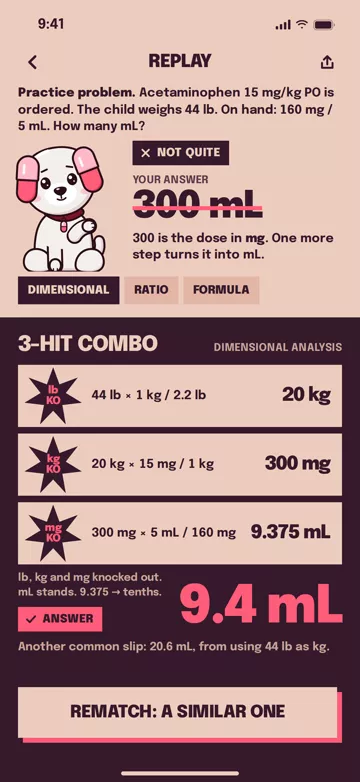
- 44 lb × (1 kg ÷ 2.2 lb) × (15 mg ÷ 1 kg) × (5 mL ÷ 160 mg)
- = 9.375 mL, rounded to the tenth
= 9.4 mL
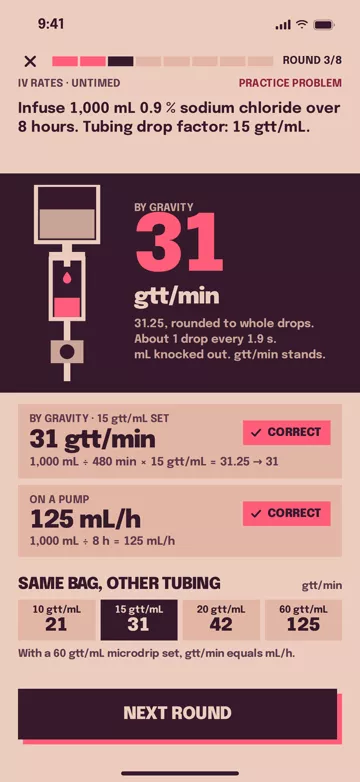
- (1,000 mL ÷ 8 hr) × (15 gtt ÷ 1 mL) × (1 hr ÷ 60 min)
- = 31.25, rounded to the whole drop
= 31 gtt/min
Why units are your safety check
If you set a fraction upside down, the units will not cancel: you end with mg²/mL or something equally strange. That is the method telling you to fix the setup before you calculate. With the formula method a flipped fraction still gives a clean-looking wrong number.
Common slips
- Writing the supply as 125 mg/5 mL when you need 5 mL/125 mg to cancel mg.
- Leaving a conversion out (0.5 g used as 0.5 mg).
- Rounding the kilograms before the last step.
Try it on the practice problems; each one shows the dimensional-analysis line.