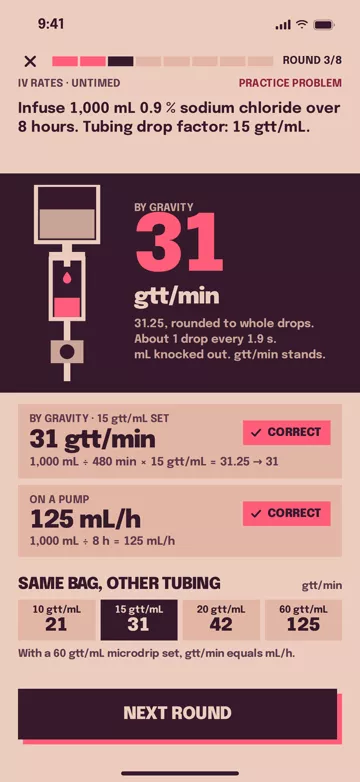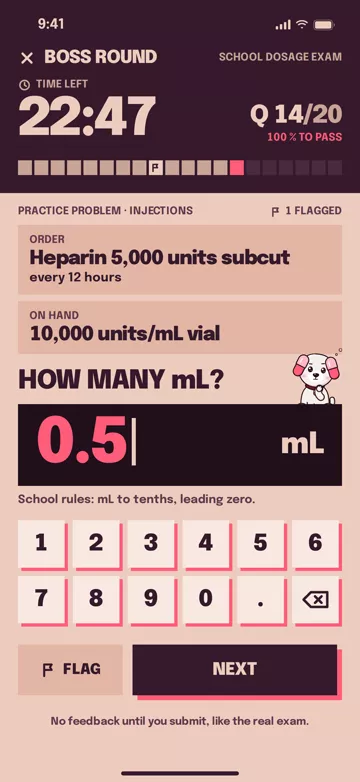
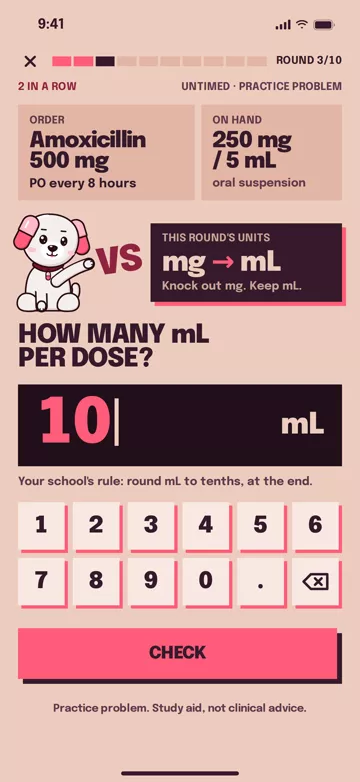
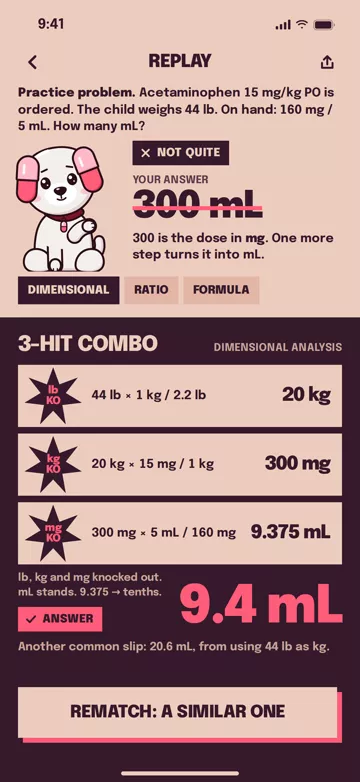
Each problem is a practice problem: real drugs and common strengths, with the rounding rule stated. Try it on paper, then open the answer to see every step, the dimensional-analysis line and the most common wrong answer. In the Pharm Pup app you type the answer and get the same worked steps:
Jump to: Tablets · Oral liquids · Injections · Weight-based (mg/kg) · IV pump rates (mL/hr) · IV gravity drips (gtt/min) · Reconstitution · Heparin and insulin (units)
Tablets
1. Furosemide tablets
Practice problem: The order is furosemide 40 mg PO once daily. The pharmacy supplies furosemide 20 mg tablets. How many tablets will you give?
Show the answer and steps
2 tablets
- Identify the parts: desired dose (D) = 40 mg, dose on hand (H) = 20 mg, quantity (Q) = 1 tablet.
- Divide the desired dose by the dose on hand: 40 mg ÷ 20 mg = 2.
- Multiply by the quantity: 2 × 1 tablet = 2 tablets.
40 mg × (1 tablet / 20 mg) = 2 tablets
Rounding: Tablets are given whole or, if scored, to the nearest half tablet; this answer is a whole number, so no rounding was needed.
Common mistake: Answering 0.5 tablet means the ratio was flipped (20 ÷ 40); the ordered dose is bigger than one tablet, so the answer must be more than one tablet.
2. Levothyroxine: mg to mcg
Practice problem: The order is levothyroxine 0.1 mg PO once daily before breakfast. The supply is levothyroxine 50 mcg tablets. How many tablets will you give?
Show the answer and steps
2 tablets
- The order (mg) and the label (mcg) use different units, so convert first: 0.1 mg × 1,000 mcg/mg = 100 mcg.
- Divide the desired dose by the dose on hand: 100 mcg ÷ 50 mcg = 2.
- Multiply by the quantity: 2 × 1 tablet = 2 tablets.
0.1 mg × (1,000 mcg / 1 mg) × (1 tablet / 50 mcg) = 2 tablets
Rounding: Tablets are given whole or, if scored, to the nearest half tablet; this answer is a whole number, so no rounding was needed.
Common mistake: Answering 0.002 tablet comes from dividing 0.1 by 50 without converting mg to mcg; the units must match before you divide.
3. Metoprolol half tablet
Practice problem: The order is metoprolol tartrate 12.5 mg PO twice daily. The supply is metoprolol tartrate 25 mg scored tablets. How many tablets will you give?
Show the answer and steps
0.5 tablet
- Identify the parts: D = 12.5 mg, H = 25 mg, Q = 1 tablet.
- Divide: 12.5 mg ÷ 25 mg = 0.5.
- Multiply by the quantity: 0.5 × 1 tablet = 0.5 tablet (one half of a scored tablet).
12.5 mg × (1 tablet / 25 mg) = 0.5 tablet
Rounding: A half tablet is allowed only because the tablet is scored; 0.5 tablet is exact, so no rounding was needed.
Common mistake: Answering 2 tablets means the ratio was flipped (25 ÷ 12.5); the order is smaller than one tablet, so the answer must be less than one tablet.
Oral liquids
4. Amoxicillin suspension
Practice problem: The order is amoxicillin 250 mg PO every 8 hours. The supply is amoxicillin oral suspension 125 mg/5 mL. How many mL will you give per dose?
Show the answer and steps
10 mL
- Identify the parts: D = 250 mg, H = 125 mg, Q = 5 mL.
- Divide: 250 mg ÷ 125 mg = 2.
- Multiply by the quantity: 2 × 5 mL = 10 mL.
250 mg × (5 mL / 125 mg) = 10 mL
Rounding: Oral liquid volumes are rounded to the tenth of a mL; 10 mL is exact, so no rounding was needed.
Common mistake: Answering 2 mL stops after the division and forgets to multiply by the 5 mL that holds each 125 mg.
5. Children's acetaminophen
Practice problem: A child who weighs 16 kg has an order for acetaminophen 240 mg PO every 6 hours as needed for fever. The supply is acetaminophen oral suspension 160 mg/5 mL. How many mL will you give per dose?
Show the answer and steps
7.5 mL
- Identify the parts: D = 240 mg, H = 160 mg, Q = 5 mL.
- Divide: 240 mg ÷ 160 mg = 1.5.
- Multiply by the quantity: 1.5 × 5 mL = 7.5 mL.
- Sense check: 240 mg ÷ 16 kg = 15 mg/kg, the usual single dose for a child.
240 mg × (5 mL / 160 mg) = 7.5 mL
Rounding: Oral liquid volumes are rounded to the tenth of a mL; 7.5 mL is exact, so no rounding was needed.
Common mistake: Answering 3.3 mL means the ratio was flipped (160 ÷ 240 × 5); the order is more than 160 mg, so the volume must be more than 5 mL.
6. Cephalexin: g to mg
Practice problem: The order is cephalexin 0.5 g PO every 6 hours. The supply is cephalexin oral suspension 250 mg/5 mL. How many mL will you give per dose?
Show the answer and steps
10 mL
- Convert grams to milligrams so the order matches the label: 0.5 g × 1,000 mg/g = 500 mg.
- Divide: 500 mg ÷ 250 mg = 2.
- Multiply by the quantity: 2 × 5 mL = 10 mL.
0.5 g × (1,000 mg / 1 g) × (5 mL / 250 mg) = 10 mL
Rounding: Oral liquid volumes are rounded to the tenth of a mL; 10 mL is exact, so no rounding was needed.
Common mistake: Answering 0.01 mL comes from using 0.5 against 250 without converting grams to milligrams; always match units before you divide.
Injections
7. Ondansetron IM
Practice problem: The order is ondansetron 4 mg IM once for nausea. The vial is labeled ondansetron 2 mg/mL. How many mL will you draw up?
Show the answer and steps
2 mL
- Identify the parts: D = 4 mg, H = 2 mg, Q = 1 mL.
- Divide: 4 mg ÷ 2 mg = 2.
- Multiply by the quantity: 2 × 1 mL = 2 mL.
4 mg × (1 mL / 2 mg) = 2 mL
Rounding: Injection volumes of 1 mL or more are rounded to the tenth of a mL; 2 mL is exact, so no rounding was needed.
Common mistake: Answering 0.5 mL means the ratio was flipped (2 ÷ 4); each mL holds only 2 mg, so 4 mg needs more than 1 mL.
8. Ketorolac IM
Practice problem: A 70-year-old patient has an order for ketorolac 15 mg IM once for pain. The vial is labeled ketorolac 30 mg/mL. How many mL will you draw up?
Show the answer and steps
0.5 mL
- Identify the parts: D = 15 mg, H = 30 mg, Q = 1 mL.
- Divide: 15 mg ÷ 30 mg = 0.5.
- Multiply by the quantity: 0.5 × 1 mL = 0.5 mL.
15 mg × (1 mL / 30 mg) = 0.5 mL
Rounding: Injection volumes under 1 mL are measured to the hundredth of a mL; 0.5 mL is exact, so no rounding was needed.
Common mistake: Answering 2 mL means the ratio was flipped (30 ÷ 15); that would give 60 mg, four times the order.
9. Hydromorphone subcut
Practice problem: The order is hydromorphone 0.5 mg subcut every 4 hours as needed for severe pain. The vial is labeled hydromorphone 2 mg/mL. How many mL will you draw up?
Show the answer and steps
0.25 mL
- Identify the parts: D = 0.5 mg, H = 2 mg, Q = 1 mL.
- Divide: 0.5 mg ÷ 2 mg = 0.25.
- Multiply by the quantity: 0.25 × 1 mL = 0.25 mL.
0.5 mg × (1 mL / 2 mg) = 0.25 mL
Rounding: Injection volumes under 1 mL are measured to the hundredth of a mL with a 1 mL (tuberculin-style) syringe; 0.25 mL is exact, so no rounding was needed.
Common mistake: Rounding to 0.3 mL gives 0.6 mg, a 20% overdose of an opioid; for volumes under 1 mL keep the hundredth.
Weight-based (mg/kg)
10. Pediatric amoxicillin mg/kg/day
Practice problem: A child weighs 44 lb. The order is amoxicillin 45 mg/kg/day PO divided every 12 hours. The supply is amoxicillin oral suspension 400 mg/5 mL. How many mL will you give per dose?
Show the answer and steps
5.6 mL
- Convert pounds to kilograms: 44 lb ÷ 2.2 lb/kg = 20 kg.
- Find the daily dose: 45 mg/kg/day × 20 kg = 900 mg/day.
- Every 12 hours means 2 doses a day: 900 mg ÷ 2 = 450 mg per dose.
- Find the volume: 450 mg × 5 mL ÷ 400 mg = 5.625 mL.
- Round to the tenth: 5.6 mL per dose.
44 lb × (1 kg / 2.2 lb) × (45 mg / kg/day) × (1 day / 2 doses) × (5 mL / 400 mg) = 5.625 mL ≈ 5.6 mL
Rounding: Weight is not rounded; the final oral volume is rounded to the tenth of a mL (5.625 mL becomes 5.6 mL).
Common mistake: Answering about 11.3 mL gives the whole daily amount (900 mg) as one dose; divide the daily dose by the number of doses first.
11. Safe dose check: acetaminophen
Practice problem: A child weighs 33 lb. The order is acetaminophen 240 mg PO every 6 hours as needed for fever. The reference safe range is 10 to 15 mg/kg per dose. What is the maximum safe single dose, and is the order safe?
Show the answer and steps
225 mg maximum; the 240 mg order is above the safe range
- Convert pounds to kilograms: 33 lb ÷ 2.2 lb/kg = 15 kg.
- Low end of the range: 10 mg/kg × 15 kg = 150 mg.
- High end of the range: 15 mg/kg × 15 kg = 225 mg.
- Compare: the safe range is 150 to 225 mg per dose, and the order of 240 mg is more than 225 mg.
- The order is not safe as written: hold the dose and contact the prescriber to clarify.
33 lb × (1 kg / 2.2 lb) × (15 mg / kg) = 225 mg (maximum per dose)
Rounding: No rounding: 33 lb converts to exactly 15 kg, and the range is compared with the order as calculated.
Common mistake: Using 33 kg instead of 15 kg (skipping the lb to kg step) gives a range of 330 to 495 mg and makes the 240 mg order wrongly look too low.
12. Enoxaparin mg/kg
Practice problem: An adult patient weighs 176 lb. The order is enoxaparin 1 mg/kg subcut every 12 hours. The supply is enoxaparin 100 mg/mL. How many mL will you give per dose?
Show the answer and steps
0.8 mL
- Convert pounds to kilograms: 176 lb ÷ 2.2 lb/kg = 80 kg.
- Find the dose: 1 mg/kg × 80 kg = 80 mg.
- Find the volume: 80 mg ÷ 100 mg/mL = 0.8 mL.
176 lb × (1 kg / 2.2 lb) × (1 mg / kg) × (1 mL / 100 mg) = 0.8 mL
Rounding: Injection volumes under 1 mL are measured to the hundredth of a mL; 0.8 mL is exact, so no rounding was needed.
Common mistake: Answering 1.76 mL uses the weight in pounds (176 mg); convert to kilograms before applying a mg/kg order.
IV pump rates (mL/hr)
13. Infusion time in hours and minutes
Practice problem: 1,000 mL of 0.9% sodium chloride is infusing by pump at 120 mL/hr. How long will the bag take to infuse? Give the answer in minutes and in hours and minutes.
Show the answer and steps
500 min (8 hr 20 min)
- Infusion time = volume ÷ rate: 1,000 mL ÷ 120 mL/hr = 8.333 hr.
- Convert to minutes: 1,000 mL ÷ 120 mL/hr × 60 min/hr = 500 min.
- Split into hours and minutes: 500 min = 8 hr (480 min) + 20 min, so 8 hr 20 min.
1,000 mL × (1 hr / 120 mL) × (60 min / 1 hr) = 500 min = 8 hr 20 min
Rounding: No rounding: the leftover 0.333… hr is converted to minutes (× 60) instead of being rounded.
Common mistake: Reading 8.33 hr as "8 hr 33 min" mixes a decimal with minutes; 0.33 hr is about 20 min (0.333 × 60).
14. Ceftriaxone piggyback rate
Practice problem: The order is ceftriaxone 1 g in 50 mL of 0.9% sodium chloride IVPB to infuse over 30 minutes. At what rate in mL/hr will you set the pump?
Show the answer and steps
100 mL/hr
- Convert the time to hours: 30 min ÷ 60 min/hr = 0.5 hr.
- Rate = volume ÷ time: 50 mL ÷ 0.5 hr = 100 mL/hr.
50 mL / 30 min × (60 min / 1 hr) = 100 mL/hr
Rounding: Pump rates are rounded to the whole mL/hr for a typical pump; 100 mL/hr is exact, so no rounding was needed.
Common mistake: Answering 1.7 mL/hr divides 50 mL by 30 minutes (that is mL per minute) and labels it per hour; pumps run in mL per hour.
15. Liters to mL/hr
Practice problem: The order is 1 L of D5W with 0.45% sodium chloride IV over 6 hours by pump. At what rate in mL/hr will you set the pump?
Show the answer and steps
167 mL/hr
- Convert liters to milliliters: 1 L × 1,000 mL/L = 1,000 mL.
- Rate = volume ÷ time: 1,000 mL ÷ 6 hr = 166.67 mL/hr.
- Round to the whole number for the pump: 167 mL/hr.
1 L × (1,000 mL / 1 L) / 6 hr = 166.67 mL/hr ≈ 167 mL/hr
Rounding: This pump is set in whole mL/hr, so 166.67 mL/hr is rounded to 167 mL/hr (round only at the end).
Common mistake: Answering 0.17 mL/hr skips the liter to milliliter conversion (1 ÷ 6); the bag holds 1,000 mL, not 1 mL.
IV gravity drips (gtt/min)
16. Macrodrip 10 gtt/mL
Practice problem: The order is 1,000 mL of lactated Ringer's IV over 8 hours by gravity. The tubing drip factor is 10 gtt/mL. How many drops per minute will you count?
Show the answer and steps
21 gtt/min
- Convert the time to minutes: 8 hr × 60 min/hr = 480 min.
- Total drops: 1,000 mL × 10 gtt/mL = 10,000 gtt.
- Drops per minute: 10,000 gtt ÷ 480 min = 20.83 gtt/min.
- Round to the whole drop: 21 gtt/min.
1,000 mL / 480 min × 10 gtt/mL = 20.83 gtt/min ≈ 21 gtt/min
Rounding: Drops cannot be split, so gtt/min is rounded to the nearest whole drop (20.83 becomes 21).
Common mistake: Answering 1,250 gtt/min divides by 8 hours instead of 480 minutes; a gravity drip is counted per minute.
17. Macrodrip 15 gtt/mL
Practice problem: The order is 500 mL of 0.9% sodium chloride IV over 4 hours by gravity. The tubing drip factor is 15 gtt/mL. How many drops per minute will you count?
Show the answer and steps
31 gtt/min
- Convert the time to minutes: 4 hr × 60 min/hr = 240 min.
- Total drops: 500 mL × 15 gtt/mL = 7,500 gtt.
- Drops per minute: 7,500 gtt ÷ 240 min = 31.25 gtt/min.
- Round to the whole drop: 31 gtt/min.
500 mL / 240 min × 15 gtt/mL = 31.25 gtt/min ≈ 31 gtt/min
Rounding: gtt/min is rounded to the nearest whole drop (31.25 becomes 31).
Common mistake: Answering 125 gtt/min uses the mL/hr rate (500 ÷ 4) as if it were drops per minute; convert hours to minutes and multiply by the drip factor.
18. Microdrip 60 gtt/mL
Practice problem: A child has an order for 300 mL of D5W with 0.9% sodium chloride IV over 4 hours by gravity. The tubing is microdrip, 60 gtt/mL. How many drops per minute will you count?
Show the answer and steps
75 gtt/min
- Convert the time to minutes: 4 hr × 60 min/hr = 240 min.
- Total drops: 300 mL × 60 gtt/mL = 18,000 gtt.
- Drops per minute: 18,000 gtt ÷ 240 min = 75 gtt/min.
- Shortcut check: with 60 gtt/mL tubing, gtt/min equals mL/hr, and 300 mL ÷ 4 hr = 75 mL/hr.
300 mL / 240 min × 60 gtt/mL = 75 gtt/min
Rounding: gtt/min is rounded to the nearest whole drop; 75 is exact, so no rounding was needed.
Common mistake: Answering 19 gtt/min uses a 15 gtt/mL macrodrip factor instead of the 60 gtt/mL printed on the microdrip tubing.
Reconstitution
19. Cefazolin 1 g vial
Practice problem: The order is cefazolin 500 mg IM every 8 hours. The vial contains cefazolin 1 g powder. The label says: add 2.5 mL of sterile water for injection to give about 330 mg/mL. How many mL will you draw up after reconstitution?
Show the answer and steps
1.5 mL
- Use the concentration printed on the label after mixing: 330 mg/mL (the powder adds volume, so it is not 1,000 mg in 2.5 mL).
- Find the volume: 500 mg ÷ 330 mg/mL = 1.52 mL.
- Round to the tenth: 1.5 mL.
500 mg × (1 mL / 330 mg) = 1.52 mL ≈ 1.5 mL
Rounding: Injection volumes of 1 mL or more are rounded to the tenth of a mL (1.52 mL becomes 1.5 mL).
Common mistake: Answering 1.3 mL assumes 1,000 mg in 2.5 mL (400 mg/mL); the powder displaces volume, so use the label's 330 mg/mL.
20. Ceftriaxone 1 g IM
Practice problem: The order is ceftriaxone 500 mg IM once. The vial contains ceftriaxone 1 g powder. The label says: for IM use, add 2.1 mL of 1% lidocaine (without epinephrine) to give 350 mg/mL. How many mL will you draw up?
Show the answer and steps
1.4 mL
- Use the label concentration after mixing: 350 mg/mL.
- Find the volume: 500 mg ÷ 350 mg/mL = 1.43 mL.
- Round to the tenth: 1.4 mL.
500 mg × (1 mL / 350 mg) = 1.43 mL ≈ 1.4 mL
Rounding: Injection volumes of 1 mL or more are rounded to the tenth of a mL (1.43 mL becomes 1.4 mL).
Common mistake: Answering 0.7 mL means the ratio was flipped (350 ÷ 500); 500 mg is more than one mL's worth of 350 mg.
21. Vancomycin 1 g vial
Practice problem: The order is vancomycin 750 mg IV every 12 hours. The vial contains vancomycin 1 g powder. The label says: add 20 mL of sterile water for injection to give 50 mg/mL. How many mL will you withdraw to add to the IV bag?
Show the answer and steps
15 mL
- Check the label concentration: 1 g = 1,000 mg, and 1,000 mg ÷ 20 mL = 50 mg/mL.
- Find the volume: 750 mg ÷ 50 mg/mL = 15 mL.
750 mg × (1 mL / 50 mg) = 15 mL
Rounding: Volumes of 1 mL or more are rounded to the tenth of a mL; 15 mL is exact, so no rounding was needed.
Common mistake: Answering 20 mL adds the whole vial (1 g), which is 250 mg more than the 750 mg ordered.
Heparin and insulin (units)
22. Heparin mL/hr to units/hr
Practice problem: A heparin infusion of 25,000 units in 250 mL D5W is running by pump at 12 mL/hr. How many units per hour is the patient receiving?
Show the answer and steps
1,200 units/hr
- Find the concentration: 25,000 units ÷ 250 mL = 100 units/mL.
- Multiply by the rate: 12 mL/hr × 100 units/mL = 1,200 units/hr.
12 mL/hr × (25,000 units / 250 mL) = 1,200 units/hr
Rounding: No rounding was needed; the result is a whole number of units per hour.
Common mistake: Answering 0.12 units/hr divides the rate by the concentration (12 ÷ 100); mL/hr times units/mL gives units/hr.
23. Weight-based heparin infusion
Practice problem: A patient weighs 80 kg. The protocol order is heparin 18 units/kg/hr IV. The bag is heparin 25,000 units in 500 mL D5W. The pump is programmed to the tenth of a mL/hr. At what rate will you set the pump?
Show the answer and steps
28.8 mL/hr
- Find the hourly dose: 18 units/kg/hr × 80 kg = 1,440 units/hr.
- Find the concentration: 25,000 units ÷ 500 mL = 50 units/mL.
- Find the rate: 1,440 units/hr ÷ 50 units/mL = 28.8 mL/hr.
18 units/kg/hr × 80 kg × (500 mL / 25,000 units) = 28.8 mL/hr
Rounding: This pump accepts tenths, so the rate is kept to the tenth of a mL/hr; 28.8 mL/hr is exact.
Common mistake: Answering 14.4 mL/hr uses 100 units/mL, the concentration of a 250 mL bag; always check the bag volume on the label.
24. Insulin infusion units/kg/hr
Practice problem: A patient weighs 70 kg. The order is regular insulin 0.1 units/kg/hr IV. The bag is regular insulin (U-100) 100 units in 100 mL of 0.9% sodium chloride. At what rate in mL/hr will you set the pump?
Show the answer and steps
7 mL/hr
- Find the hourly dose: 0.1 units/kg/hr × 70 kg = 7 units/hr.
- Find the concentration: 100 units ÷ 100 mL = 1 unit/mL.
- Find the rate: 7 units/hr ÷ 1 unit/mL = 7 mL/hr.
0.1 units/kg/hr × 70 kg × (100 mL / 100 units) = 7 mL/hr
Rounding: No rounding was needed; 7 mL/hr is a whole number.
Common mistake: Answering 70 mL/hr drops the decimal in 0.1 units/kg/hr, a tenfold overdose; insulin is a high-alert drug, so have a second nurse double-check.