Read the label in this order
- Diluent: which one (sterile water, normal saline, 1% lidocaine for some IM antibiotics) and how much.
- Route: IM and IV directions often use different volumes.
- Final concentration: the mg per mL after mixing. This is the number you calculate with.
- Storage: how long the mixed drug keeps, and at what temperature. Label the vial with date, time, concentration and your initials.
Why not just divide by the diluent?
The powder itself takes up space (displacement). If you add 2.5 mL to a 1 g vial, the total volume is a little more than 2.5 mL, so the concentration is lower than 1,000 ÷ 2.5. Labels state the true concentration; use it.
Worked examples
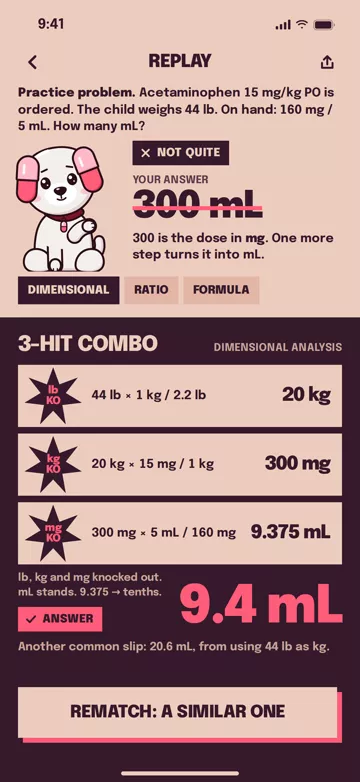
- 500 mg ÷ 330 mg/mL = 1.52 mL
= 1.5 mL
- 500 mg ÷ 350 mg/mL = 1.43 mL
= 1.4 mL
- 750 mg ÷ 50 mg/mL
= 15 mL
Label concentrations differ between manufacturers. The numbers above are for practice; in clinical work use the label in your hand and your facility's references.
Common mistakes
- Using 1,000 mg ÷ 2.5 mL = 400 mg/mL for cefazolin, which ignores displacement.
- Choosing the IV dilution for an IM dose, which gives a volume too large to inject.
- Forgetting that 1 g = 1,000 mg.
Practise: reconstitution practice problems.