43 terms you will meet in med math and dosage calculation, in plain words. Each links to related terms. The Pharm Pup app uses the same words on every screen:
- Body surface area (BSA)
Some drugs, such as many chemotherapy agents, are dosed per square meter of body surface area. The Mosteller formula is BSA (m²) = √(height in cm × weight in kg ÷ 3,600). Example: 170 cm and 70 kg gives √(11,900 ÷ 3,600) = √3.31, about 1.82 m².
Related: mg/kg (weight-based dosing), Safe dose range
- Concentration
Concentration is the amount of drug per unit of volume. Find it by dividing the total drug by the total volume. Example: heparin 25,000 units in 250 mL is 25,000 ÷ 250 = 100 units/mL.
Related: Dose on hand (H), Reconstitution, Unit
- Conversion factor
Common factors in med math: 1 kg = 2.2 lb, 1 g = 1,000 mg, 1 mg = 1,000 mcg, 1 L = 1,000 mL, 1 tsp = 5 mL, 1 tbsp = 15 mL and 1 oz = 30 mL (as commonly taught). Example: 154 lb ÷ 2.2 = 70 kg. Write each factor as a fraction so the unit you want to remove cancels.
Related: Dimensional analysis, mcg (microgram), mg/kg (weight-based dosing)
- Desired dose (D)
The desired dose is the ordered amount for a single administration, such as 500 mg or 1,000 units. For weight-based orders you calculate it first from the patient's weight. Make sure it is in the same unit as the dose on hand before you divide.
Related: Dose on hand (H), Formula method (D/H × Q), mg/kg (weight-based dosing)
- Diluent
A diluent is the liquid added during reconstitution. The label names which one to use, for example sterile water for injection, 0.9% sodium chloride, or 1% lidocaine for some IM antibiotics. Using the wrong diluent or the wrong amount changes the concentration.
Related: Reconstitution, Concentration
- Dimensional analysis
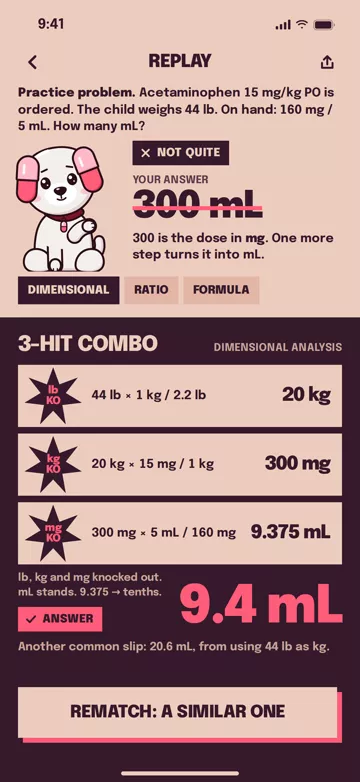
Dimensional analysis writes the problem as a chain of fractions, each built from a known fact such as a label concentration or a conversion factor. Units that appear on the top and bottom cancel, and the unit left over is the unit of the answer. Example: an order for 250 mg with a supply of 125 mg/5 mL becomes 250 mg × 5 mL / 125 mg = 10 mL. If the units do not cancel to the unit you want, the setup is wrong.
Related: Ratio and proportion, Formula method (D/H × Q), Conversion factor
- Displacement
Powder takes up space once it dissolves, so the final volume is larger than the diluent volume. Example: cefazolin 1 g with 2.5 mL of diluent yields about 3 mL at about 330 mg/mL, not 400 mg/mL (1,000 mg ÷ 2.5 mL). This is why you use the concentration on the label, not your own division.
Related: Reconstitution, Concentration
- Dose on hand (H)
The dose on hand is the strength printed on the label: per tablet, per capsule, or per stated volume. For a suspension labeled 250 mg/5 mL, H is 250 mg and Q is 5 mL. Always read the strength, not just the drug name.
Related: Desired dose (D), Quantity (vehicle), Concentration
- Drip factor
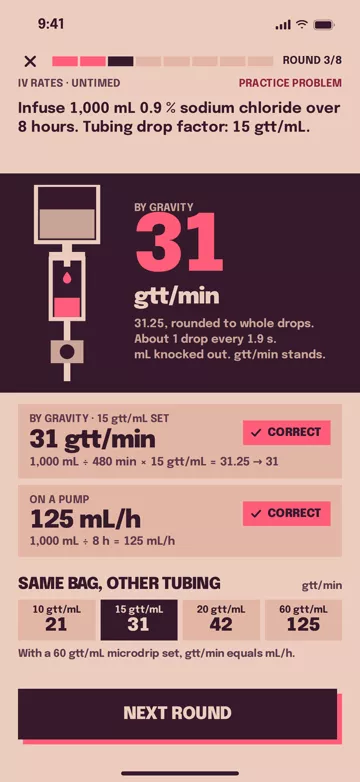
The drip factor is fixed by the tubing: macrodrip sets deliver 10, 15 or 20 gtt/mL, and microdrip sets deliver 60 gtt/mL. Use it to convert a volume into drops for a gravity infusion. Example: 100 mL over 30 minutes with 20 gtt/mL tubing is 100 × 20 ÷ 30 = 66.7, rounded to 67 gtt/min.
Related: Macrodrip, Microdrip, gtt (drops), Flow rate
- Enteric-coated (EC)
An enteric coating protects the drug from stomach acid or protects the stomach from the drug, so the tablet dissolves in the small intestine. Crushing or splitting it destroys the coating. If the patient cannot swallow it, ask the pharmacist for another form.
Related: Scored tablet, Suspension
- Flow rate
Flow rate is the speed of an infusion. Pumps are set in mL/hr; gravity lines are counted in gtt/min. Example: 1,000 mL over 8 hours is 1,000 ÷ 8 = 125 mL/hr.
Related: mL/hr, gtt (drops), Infusion time, Volume to be infused (VTBI)
- Formula method (D/H × Q)
The formula method divides the desired dose (D) by the dose on hand (H) and multiplies by the quantity (Q). Example: the order is 40 mg and tablets are 20 mg, so 40 ÷ 20 × 1 tablet = 2 tablets. D and H must be in the same unit, so convert first if they differ.
Related: Desired dose (D), Dose on hand (H), Quantity (vehicle), Dimensional analysis
- gtt (drops)
In IV math, gtt means drops and gtt/min is the gravity flow rate you count in the drip chamber. Drops cannot be split, so gtt/min is rounded to a whole number. Drop size depends on the tubing's drip factor.
Related: Drip factor, Flow rate
- Infusion time
Infusion time = volume ÷ rate. Example: 500 mL at 100 mL/hr takes 500 ÷ 100 = 5 hours. Convert decimal hours to minutes by multiplying the decimal part by 60, so 0.5 hr is 30 minutes.
Related: Flow rate, Volume to be infused (VTBI)
- Insulin syringe
Insulin syringes are marked in units, not mL, and match U-100 insulin. The 0.3 mL size holds up to 30 units, 0.5 mL up to 50 units, and 1 mL up to 100 units. Never use an insulin syringe for other drugs or a tuberculin syringe for insulin.
Related: U-100 insulin, Tuberculin syringe
- ISMP do-not-use abbreviations
ISMP keeps a list of error-prone abbreviations, and The Joint Commission has a minimum Do Not Use list. Examples: U and IU (write "units"), QD and QOD (write "daily" and "every other day"), MS and MSO4 (write "morphine sulfate"), µg (write "mcg"), cc (write "mL"), trailing zeros (5.0 mg) and naked decimals (.5 mg).
Related: Leading zero, Trailing zero, Unit, mcg (microgram)
- IVPB (IV piggyback)
A piggyback is a small bag, often an antibiotic, that runs through the primary IV line. On a gravity setup it hangs higher than the primary bag; on a pump it is programmed as a secondary infusion. Example: 50 mL over 30 minutes is 50 ÷ 0.5 = 100 mL/hr.
Related: Volume to be infused (VTBI), mL/hr, Flow rate
- KVO (keep vein open)
KVO, also called TKO (to keep open), runs fluid just fast enough to keep the IV catheter open. The exact rate comes from the order or your facility's policy. It still counts toward the patient's fluid intake.
- Leading zero
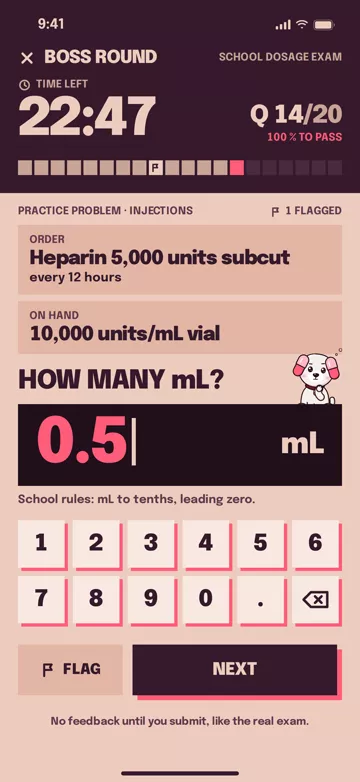
A dose under 1 must be written with a zero before the decimal point, such as 0.5 mg. Writing .5 mg (a naked decimal) risks the point being missed and the dose read as 5 mg, a tenfold overdose. This is part of the ISMP and Joint Commission safety rules.
Related: Trailing zero, ISMP do-not-use abbreviations
- Loading dose
A loading dose raises the blood level of a drug quickly. Example: a weight-based heparin protocol may start with a bolus of 80 units/kg, which for an 80 kg patient is 80 × 80 = 6,400 units. The infusion then continues at a maintenance rate.
Related: Maintenance dose, Titration, mg/kg (weight-based dosing)
- Macrodrip
Macrodrip tubing makes larger drops, so fewer drops make up each mL. Common drip factors are 10, 15 and 20 gtt/mL; check the package, because brands differ. It suits higher volumes and faster rates.
Related: Microdrip, Drip factor, gtt (drops)
- Maintenance dose
After a loading dose, the maintenance dose keeps the drug level steady. It is often given as a continuous infusion or a scheduled dose, such as heparin 18 units/kg/hr in a weight-based protocol. It may be adjusted by protocol based on lab results.
Related: Loading dose, Titration
- MAR (medication administration record)
The MAR lists each ordered drug with its dose, route, time and frequency, and is where you document each dose given, held or refused. Compare the MAR with the order and the label before giving a drug. Most hospitals use an electronic MAR (eMAR) with barcode scanning.
Related: Rights of medication administration, PRN
- mcg (microgram)
A microgram is 1/1,000 of a milligram. To change mg to mcg, multiply by 1,000; to change mcg to mg, divide by 1,000. Example: 0.125 mg = 125 mcg. Write "mcg" because the Greek symbol can be misread as mg.
Related: Conversion factor, ISMP do-not-use abbreviations, Leading zero
- mEq (milliequivalent)
Electrolytes like potassium chloride are ordered in milliequivalents (mEq). Solve them like any other dose. Example: potassium chloride oral solution 20 mEq/15 mL with an order for 40 mEq gives 40 × 15 ÷ 20 = 30 mL.
Related: Concentration, Formula method (D/H × Q)
- mg/kg (weight-based dosing)
Weight-based orders give a dose per kilogram, so first convert pounds to kilograms (2.2 lb = 1 kg). Example: a 22 lb child is 22 ÷ 2.2 = 10 kg, and an order of 10 mg/kg is 10 × 10 = 100 mg. Watch for per dose versus per day (mg/kg/day) orders.
Related: Safe dose range, Conversion factor, Body surface area (BSA)
- Microdrip
Microdrip tubing forms small drops at 60 gtt/mL and is used for slow or precise gravity infusions, often in children. Because there are 60 drops in each mL and 60 minutes in each hour, gtt/min equals mL/hr. Example: 45 mL/hr runs at 45 gtt/min.
Related: Macrodrip, Drip factor, mL/hr
- mL/hr
Most infusion pumps are programmed in mL/hr. If the time is in minutes, convert to hours or multiply by 60. Example: 50 mL over 20 minutes is 50 ÷ 20 × 60 = 150 mL/hr. Many pumps take whole numbers; some accept tenths.
Related: Flow rate, Microdrip, Infusion time
- PRN
PRN comes from the Latin pro re nata, "as needed." A complete PRN order states the drug, dose, route, minimum time between doses and the reason, such as "every 4 hours as needed for pain." Document why you gave it and the patient's response.
Related: MAR (medication administration record), Rights of medication administration
- Quantity (vehicle)
The quantity, also called the vehicle, is the amount of tablet, capsule or liquid that contains the dose on hand. For tablets it is usually 1 tablet; for a liquid it is the volume on the label, such as 5 mL. Forgetting to multiply by Q is a common error with liquids.
Related: Dose on hand (H), Formula method (D/H × Q), Suspension
- Ratio and proportion
Ratio and proportion compares what you have with what you need. Example: 125 mg : 5 mL = 250 mg : x mL. Cross-multiply to get 125x = 1,250, so x = 10 mL. Keep the same units in the same position on both sides.
Related: Dimensional analysis, Formula method (D/H × Q)
- Reconstitution
Many injectable drugs come as a powder because they are unstable in liquid. The label tells you which diluent to use, how much to add and the resulting concentration. Use the concentration printed on the label, and label a multidose vial with the date, time, concentration and your initials.
Related: Diluent, Concentration, Displacement
- Rights of medication administration
The core rights are the right patient, right drug, right dose, right route, right time and right documentation; many programs add right reason, right response, right to refuse and right education. Dose calculation is part of the right dose. Do the checks at each step, not only once.
Related: MAR (medication administration record), Safe dose range, PRN
- Rounding to the tenth
Most programs round mL doses to the tenth and round only at the final step. Look at the hundredths digit: 5.625 mL becomes 5.6 mL, and 1.46 mL becomes 1.5 mL. Volumes under 1 mL are often kept to the hundredth, and gtt/min is rounded to a whole drop. Follow your school's rounding policy.
Related: Tuberculin syringe, gtt (drops)
- Safe dose range
To check an order, multiply the reference range by the patient's weight and see whether the order falls inside it. Example: for a 20 kg child and a range of 10 to 15 mg/kg per dose, the safe range is 200 to 300 mg, so an order of 250 mg is within range. If an order is outside the range, hold it and contact the prescriber.
Related: mg/kg (weight-based dosing), Body surface area (BSA), Rights of medication administration
- Scored tablet
A score line lets a tablet be broken into equal parts. Example: an order for 12.5 mg with 25 mg scored tablets is 12.5 ÷ 25 = 0.5 tablet. Do not split unscored, enteric-coated or extended-release tablets.
Related: Enteric-coated (EC), Formula method (D/H × Q)
- Suspension
In a suspension, the drug particles settle over time, so shake the bottle before each dose to spread the drug evenly. The label gives the strength per volume, such as amoxicillin 250 mg/5 mL. Measure with an oral syringe or dosing cup marked in mL, not a kitchen spoon.
Related: Quantity (vehicle), Dose on hand (H), Conversion factor
- Titration
Titration means changing a dose stepwise to reach a target, such as a blood pressure, glucose or lab value. Orders for titrated drips state the starting dose, the step size, how often to adjust and the maximum. Each new dose needs a new rate calculation.
Related: Loading dose, Maintenance dose, mL/hr
- Trailing zero
A trailing zero, as in 5.0 mg, can be misread as 50 mg if the decimal point is missed. Write whole-number doses without a decimal: 5 mg. The exception is a lab value or equipment size where the precision matters, not a medication order.
Related: Leading zero, ISMP do-not-use abbreviations
- Tuberculin syringe
A tuberculin syringe holds 1 mL and is marked in hundredths, so it can measure small doses like 0.25 mL accurately. It is used for skin tests and small injection volumes. It is marked in mL, not units, so it is not used for insulin.
Related: Insulin syringe, Rounding to the tenth
- U-100 insulin
U-100 means 100 units per mL. Example: 20 units of U-100 insulin is 20 ÷ 100 = 0.2 mL, but you measure it in units on a U-100 insulin syringe, not in mL. Other strengths, such as U-500, need special care and their own devices.
Related: Insulin syringe, Unit, Concentration
- Unit
Some drugs, such as heparin and insulin, are measured in units of activity rather than milligrams. Always write the word "units" in full; the abbreviation U can be misread as a 0 or a 4 and cause a tenfold overdose. Units do not convert to mg.
Related: U-100 insulin, Concentration, ISMP do-not-use abbreviations
- Volume to be infused (VTBI)
VTBI is the volume you enter on the pump, such as 50 mL for a piggyback or 1,000 mL for a liter bag. The pump stops or alarms when the VTBI has been delivered. It is entered with the rate in mL/hr.
Related: Flow rate, Infusion time, IVPB (IV piggyback)