The steps
- Weight in kg: kg = lb ÷ 2.2. Do not round yet.
- Dose: mg/kg × kg.
- Per day or per dose? If the order says mg/kg/day divided every 12 hours, divide the daily dose by 2 (every 8 hours: by 3; every 6 hours: by 4).
- Volume: dose ÷ concentration (D/H × Q).
- Safe range check: compare the ordered dose with the reference range for that weight.
Worked examples
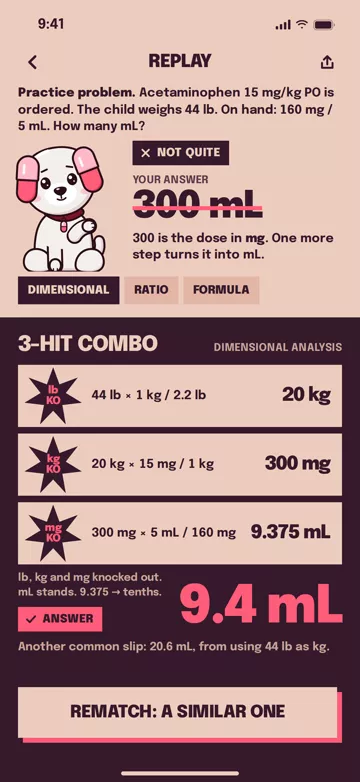
- 44 lb ÷ 2.2 = 20 kg
- 15 mg/kg × 20 kg = 300 mg
- 300 mg ÷ 160 mg × 5 mL = 9.375 mL
= 9.4 mL
- 44 lb ÷ 2.2 = 20 kg
- 45 mg/kg/day × 20 kg = 900 mg/day
- 900 mg ÷ 2 doses = 450 mg per dose
- 450 mg ÷ 400 mg × 5 mL = 5.625 mL
= 5.6 mL per dose
Safe dose range check
Many questions give a reference range and ask whether the order is safe. Work out the range for the child's weight, then compare.
- 33 lb ÷ 2.2 = 15 kg
- Low end: 10 mg/kg × 15 kg = 150 mg
- High end: 15 mg/kg × 15 kg = 225 mg
- 240 mg is above 225 mg
Not safe: hold and contact the prescriber
Body surface area (BSA)
Some drugs (often chemotherapy) are dosed per m² of body surface area. The Mosteller formula is BSA (m²) = √(height in cm × weight in kg ÷ 3,600).
- 170 × 70 = 11,900
- 11,900 ÷ 3,600 = 3.31
- √3.31
= 1.82 m²
Common mistakes
- Using 44 lb as 44 kg: the dose comes out 2.2 times too large (20.6 mL instead of 9.4 mL in the first example).
- Giving the whole daily dose at once (11.3 mL instead of 5.6 mL in the second example).
- Rounding the weight to a whole kg before multiplying.
Practise: weight-based practice problems.