The three methods
Every dosage problem gives you the same three things: what the prescriber ordered (the desired dose), what the pharmacy sent (the dose on hand) and the amount it comes in (the quantity, such as 1 tablet or 5 mL). The three methods are three ways to arrange those numbers. Pick the one your school teaches, and learn a second to check yourself.
1. Dimensional analysis
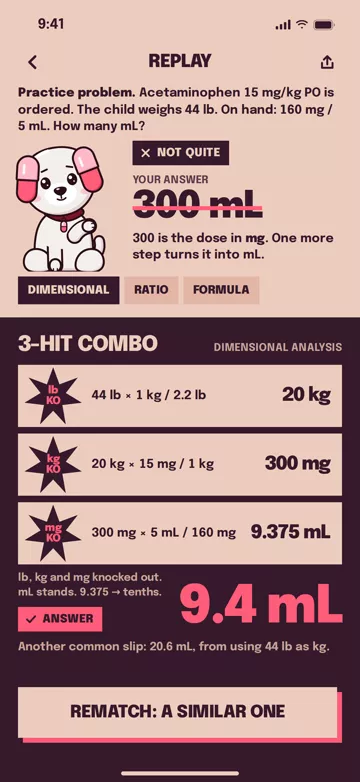
Write the order, then multiply by fractions that cancel units until only the unit you want is left. It handles conversions and multi-step problems in one line, which is why many programs teach it first. Full guide: dimensional analysis for nurses.
- 250 mg × (5 mL ÷ 125 mg)
- mg cancels, mL stays
= 10 mL
2. Formula method (D/H × Q)
Desired dose divided by what you have, times the quantity it comes in. Quick for one-step problems. Make sure D and H are in the same unit first.
- D/H × Q = 40 mg ÷ 20 mg × 1 tablet
= 2 tablets
3. Ratio and proportion
Set what you have equal to what you need and cross-multiply: 125 mg : 5 mL = 250 mg : x mL, so 125x = 1,250 and x = 10 mL. Same answer as above, which is the point of checking with a second method.
The formulas you will use most
| You need | Formula |
|---|---|
| Tablets or mL | D/H × Q |
| IV pump rate | mL/hr = total mL ÷ hours |
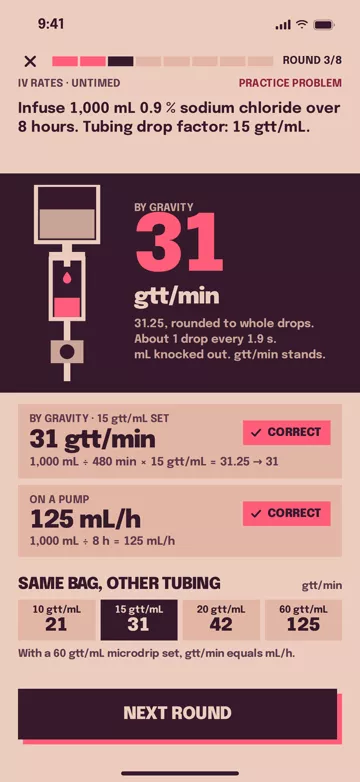
| Gravity drip | gtt/min = mL × drip factor ÷ minutes |
| Weight-based dose | dose = mg/kg × kg (kg = lb ÷ 2.2) |
| Infusion time | hours = total mL ÷ mL/hr |
| Units per hour | units/hr = mL/hr × units per mL |
All of them, with worked examples, fit on our free printable dosage formula sheet.
Five steps that stop most errors
- Read the whole order. Drug, dose, route, frequency. Note whether the dose is per dose, per day or per kg.
- Convert first. Get the order and the supply into the same unit (g to mg, mcg to mg, lb to kg). See unit conversions for nursing.
- Set up one method and cancel units on paper.
- Round once, at the end, using your school's rounding policy.
- Ask if it is reasonable. Six tablets or 40 mL of an IM injection should make you stop and recheck.
Mistakes that cost the most points
- Flipping the fraction. 125 mg ÷ 250 mg × 5 mL gives 2.5 mL instead of 10 mL. If units do not cancel, the setup is upside down.
- Stopping at mg. The order asks for mL; 300 mg is a dose, not a volume.
- Forgetting the drip factor. 125 mL/hr is a pump rate. A gravity line needs drops per minute.
- Using pounds as kilograms. A 44 lb child weighs 20 kg; using 44 more than doubles the dose.
- Rounding in the middle. Keep every digit until the last step.
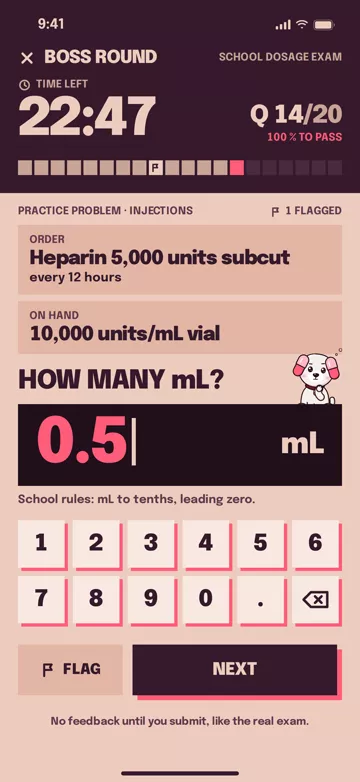
- Trailing zeros and naked decimals. Write 5 mg, never 5.0 mg, and 0.5 mg, never .5 mg (ISMP).
Where to go next
Work through the 24 practice problems with answers, then the topic guides: IV drip rates, mg/kg dosing and reconstitution.