IV drip rate formulas

Pup, the Pharm Pup mascot, thinking

Two questions cover almost every IV problem: how many mL per hour for a pump, and how many drops per minute for a gravity line.

Pump rate: mL/hr

mL/hr = total volume (mL) ÷ time (hr)

Practice problem: 1,000 mL over 8 hr
  1. 1,000 mL ÷ 8 hr

= 125 mL/hr

When the time is in minutes, convert to hours or multiply by 60:

Practice problem: IV piggyback, 50 mL over 30 min
  1. 50 mL ÷ 30 min × 60 min/hr

= 100 mL/hr

Gravity rate: gtt/min

gtt/min = volume (mL) × drip factor (gtt/mL) ÷ time (min)

The drip factor is printed on the tubing package. Macrodrip sets are usually 10, 15 or 20 gtt/mL; microdrip sets are 60 gtt/mL. You cannot give part of a drop, so round to the whole drop.

Practice problem: 1,000 mL over 8 hr (480 min)
Drip factorSetupRate
10 gtt/mL1,000 × 10 ÷ 480 = 20.8321 gtt/min
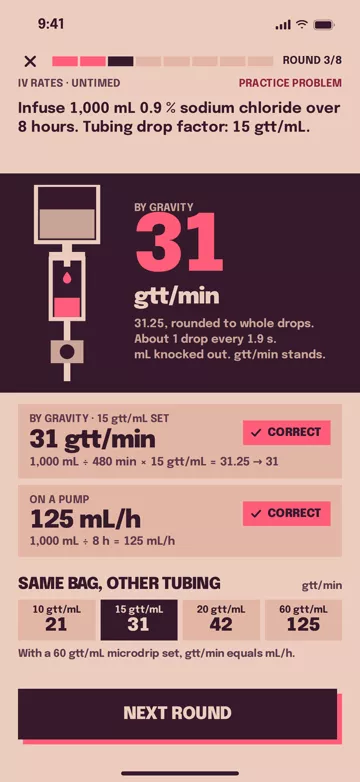
15 gtt/mL1,000 × 15 ÷ 480 = 31.2531 gtt/min
20 gtt/mL1,000 × 20 ÷ 480 = 41.6742 gtt/min
60 gtt/mL1,000 × 60 ÷ 480 = 125125 gtt/min

The microdrip shortcut

With a 60 gtt/mL set, drops per minute equal mL per hour, because the 60 drops per mL and the 60 minutes per hour cancel. 125 mL/hr on a microdrip set is 125 gtt/min.

Infusion time

time (hr) = total volume (mL) ÷ rate (mL/hr)

Practice problem: 1,000 mL at 120 mL/hr
  1. 1,000 mL ÷ 120 mL/hr × 60 min/hr = 500 min
  2. 500 min = 480 min (8 hr) + 20 min

= 8 hr 20 min

Heparin and other unit-based drips

For drips ordered in units per hour, find the concentration first, then divide.

Practice problem: heparin 25,000 units in 250 mL, order 1,200 units/hr
  1. 25,000 units ÷ 250 mL = 100 units/mL
  2. 1,200 units/hr ÷ 100 units/mL

= 12 mL/hr

Common mistakes

  • Answering 125 when the question asks for gtt/min on a 15 gtt/mL set (that is the pump rate).
  • Forgetting to change hours to minutes: 1,000 × 15 ÷ 8 gives 1,875, drops per hour, not per minute.
  • Rounding 31.25 up to 32. Round to the nearest whole drop: 31.
More: IV practice problems with answers.

Questions, answered.

What is the formula for IV drip rate in gtt/min?

Drops per minute = total volume in mL × drip factor in gtt/mL ÷ time in minutes. Round to the nearest whole drop.

What are common drip factors?

Macrodrip tubing is usually 10, 15 or 20 gtt/mL; microdrip tubing is 60 gtt/mL. Always read the drip factor on the tubing package.

How do I calculate mL per hour?

Divide the total volume in mL by the time in hours. For 1,000 mL over 8 hours that is 125 mL/hr.

Why does microdrip gtt/min equal mL/hr?

Because the set gives 60 drops per mL and there are 60 minutes in an hour, so the two 60s cancel.

Practise it in the app

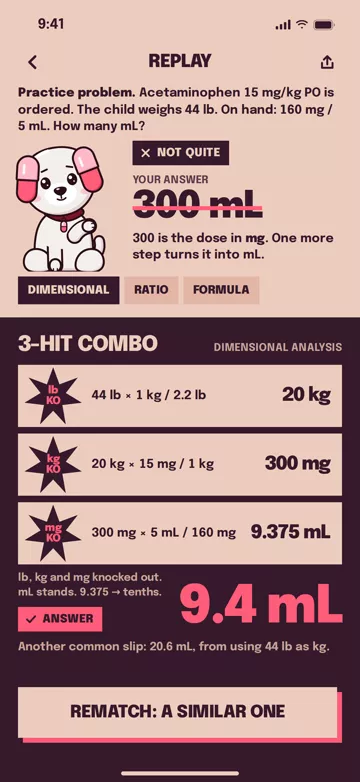
Pharm Pup app screen: The replay: lb, kg and mg knocked out until mL stands
The replay: lb, kg and mg knocked out until mL stands.
Pharm Pup app screen: An IV drip round: 31 gtt/min by gravity, 125 mL/h on a pump
An IV drip round: 31 gtt/min by gravity, 125 mL/h on a pump.
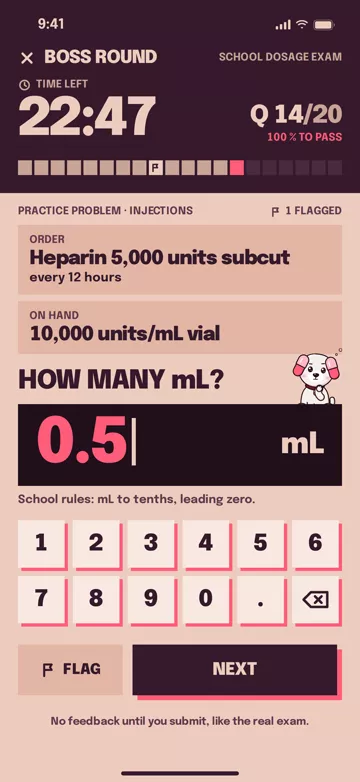
Pharm Pup app screen: A timed mock round in your school format
A timed mock round in your school format.

Sources

Practice problems for study only, not clinical advice. Follow your school's rounding policy, your facility's policy and the prescriber's order. Reviewed 2026-10-30.

Keep going